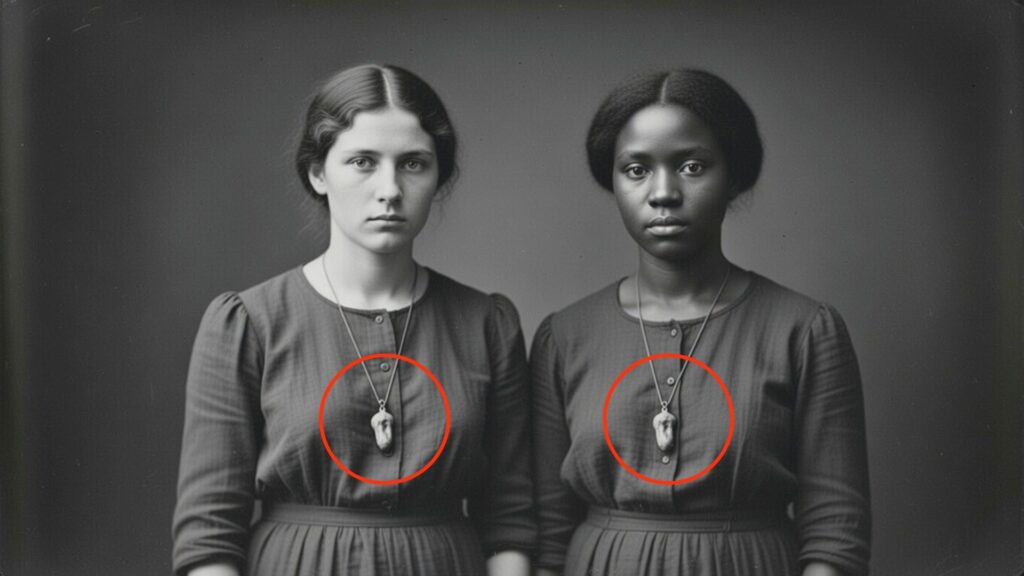
For over a century, an 1890s photograph was kept in a New England historical society’s archives within a folder marked “Unidentified”. At first glance, it appears to be a touching portrait of two young girls wearing identical mourning dresses, staring into the camera with cold, calm eyes. However, modern technology helped uncover the sinister nature of the strange objects resting on their chests.
From Stones to Human Remains
- For decades, it was assumed that the irregular, porous, and grayish pendants on their necks were just roughly carved stones or “talismans”.
- In 2025, a team of bioarchaeologists used high-precision digital analysis on the image, which yielded shocking results: the “stones” lacked any mineral structure.
- An analysis of their density and calcium content confirmed they were organic matter—specifically, human bone. They were carved into the shape of a primitive anatomical heart.
A Cruel Pseudoscience Experiment
- A major breakthrough occurred when a researcher matched the photo’s negative number with the archives of the long-demolished Blackwood Sanitarium.
- It was revealed that the girls were not friends, but regular patients of a facility known for its radical and inhumane experiments. In the medical documents, they were referred to only as “Object A” and “Object B”.
- The head physician was conducting a project known as “Sympathetic Resonance”.
- The bone pendants acted as “anchors”: the doctor believed that if two patients wore fragments of the same biological material, their nervous systems would “tune in” to one another, forcing them to feel each other’s pain.
- They were dressed identically to destroy their individuality; 19th-century psychiatric theories suggested this could “restart” a damaged psyche.
Chilling Details and the Final Outcome
- Modern psychologists note a “flat affect” on the patients’ faces—an almost complete lack of microexpressions typical of severe trauma or deep drug sedation.
- New image enhancement techniques revealed a gloved hand holding a stopwatch in the dark corner of the frame, proving the patients were not just photographed, but actively observed and timed.
- Just a week after this photo was taken, both girls were transferred to the “Permanent Isolation” wing.
- While all the sanitarium’s medical files were destroyed in a 1912 fire , this specific negative survived because it was hidden in a lead box within the doctor’s personal office.
Today, the original photograph is kept in dim light within a private collection. It serves as a silent monument to an era when the line between a doctor and an executioner was incredibly thin, and real people fell victim to dangerous pseudoscience.
Top Articles